 Motivum
SMART Goals: 25 Examples You Can Copy (Health, Money, Career)
A SMART goal is Specific, Measurable, Achievable, Relevant and Time-bound. Instead of “get healthier”, a SMART goal says “walk 8,000 steps a day, five days a week, for the next 8 weeks”. Below is a fill-in template and 25 examples you can copy.
The SMART framework in one minute
The acronym comes from George T. Doran’s 1981 article “There’s a S.M.A.R.T. way to write management’s goals and objectives” in Management Review. His letters were slightly different (Assignable, Realistic, Time-related); the Achievable and Relevant version most people use today came later. It caught on because it fixes the most common goal mistake: being too vague to know whether you’re winning.
| Letter | Means | Ask yourself |
|---|---|---|
| S | Specific | What exactly will I do? |
| M | Measurable | What number tells me I did it? |
| A | Achievable | Can I do this on a bad week? |
| R | Relevant | Why does this matter to me right now? |
| T | Time-bound | By when, and how often? |
A fill-in SMART goal template
I will [action] [amount] [how often] until [date], so that [reason].
Example: I will read 20 minutes every day until December 31, so that I finish 12 books this year.
SMART goal examples for health and fitness
- Work out 3 times a week for 45 minutes for the next 12 weeks.
- Walk 8,000 steps a day, five days a week, through the end of the month.
- Drink 2 liters of water every day for 30 days.
- Run a 5K without stopping by March 1, training three times a week.
- Go to bed by 11 p.m. on weeknights for the next 4 weeks.
- Stretch for 10 minutes every evening for 21 days.
SMART goal examples for money
- Save $300 every month until I have a $3,000 emergency fund.
- Have four no-spend weekends this month.
- Cook dinner at home five nights a week to cut takeout spending by half this quarter.
- Pay an extra $100 toward my credit card every month until it’s cleared.
SMART goal examples for career
- Apply to five relevant jobs per week until I accept an offer.
- Spend 3 hours a week on a certification course and finish it by June 30.
- Ship one portfolio project every month for the next three months.
- Have one coffee chat with someone in my field every two weeks this quarter.
- Do 2 hours of deep work before checking email, four days a week.
SMART goal examples for students
- Study 10 hours a week for the next 6 weeks before finals.
- Complete one practice exam every Sunday until the test date.
- Review flashcards for 15 minutes every day this semester.
- Finish one chapter of the textbook every two days.
SMART goal examples for personal growth
- Read 12 books this year — one per month.
- Meditate for 10 minutes every morning for 30 days.
- Call a family member twice a week.
- Journal three sentences every night for the next month.
- Practice guitar for 20 minutes, five days a week, until I can play three full songs.
- Write 300 words a day, five days a week, until my first draft is done.
Why SMART goals still fail (and how to fix it)
SMART goals fix clarity, but clarity isn’t the whole story. Goals usually fail for three other reasons:
- Too many at once. Pick one to five. Everything else waits. Tracking fewer goals is one of the simplest ways to stay motivated.
- No cue. You know what to do but nothing reminds you when. Attach the goal to a time and a trigger (“after lunch”), the same move that helps habits form faster.
- No visible progress. A goal you can’t see is a goal you forget. Put it on a tracker you look at daily.
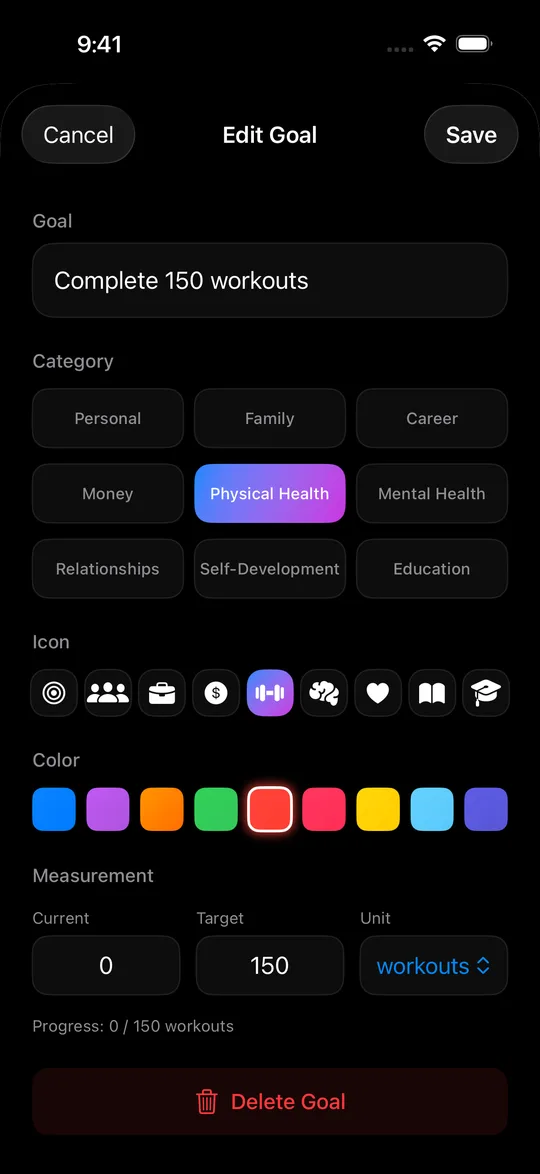
That last point is where an app helps. In Motivum, every goal gets a unit (workouts, books, km, hours, money and more), a target and a progress ring, so the “M” in SMART is built in: you always see how far you are from the number. Put the “T” in the goal’s name (“Read 12 books by December 31”) and let reminders handle the cue.
Make your goals fit your motivation style
The same SMART goal can feel exciting or dreadful depending on what motivates you. An Achiever loves “save $300 a month”. A Helper might stick with it longer as “save $300 a month so we can take the kids on a trip”. Find your style with the motivation style quiz and phrase your goals to match.
Key takeaways
- A SMART goal is Specific, Measurable, Achievable, Relevant and Time-bound; Doran's 1981 original used Assignable, Realistic and Time-related.
- Use the template: I will [action] [amount] [how often] until [date], so that [reason].
- Keep one to five goals at a time, each with a cue and a tracker you see every day.
Sources
- Doran, G. T. (1981). There’s a S.M.A.R.T. way to write management’s goals and objectives. Management Review, 70(11), 35–36. (No official online copy.)
Put this into practice
Motivum turns goals into daily progress with personalized motivation. A goal tracker app that keeps you moving →