 Motivum
Gym Motivation: 10 Tips for When You Don't Feel Like It
When you don’t feel like working out, make the workout smaller instead of skipping it. Ten minutes keeps the habit alive; zero minutes starts a new habit of skipping. Below are ten tips for the days motivation doesn’t show up.
1. Use the two-minute rule
Your only goal is to put on your workout clothes and start. Give yourself permission to stop after two minutes. Most of the time you won’t — starting is the hardest part. It’s the same trick behind most ways to stay motivated: make the next step too small to refuse.
2. Set weekly goals, not daily ones
“Work out every day” breaks the first time life gets busy. “Work out 3 times a week” survives a late night at the office. Weekly goals also give you natural rest days.
3. Schedule it like a meeting
Pick specific days and times and put them in your calendar. A workout at “some point today” competes with everything else; a workout at 7:00 a.m. Tuesday doesn’t. A review of 26 studies found that plans like this (“if it’s Tuesday at 7, I go to the gym”) increased physical activity, though the effect was modest. And in a large study of gym check-ins, going on the same days of the week was one of the clearest predictors of who kept showing up.
4. Pack your bag the night before
Every bit of friction is an excuse waiting to happen. Bag by the door, shoes out, water bottle filled.
5. Have a “minimum workout”
Decide in advance what counts on a bad day: 15 minutes, one circuit, a brisk walk. Hitting the minimum counts as a win — and it often turns into a full session.
6. Track it where you’ll see it
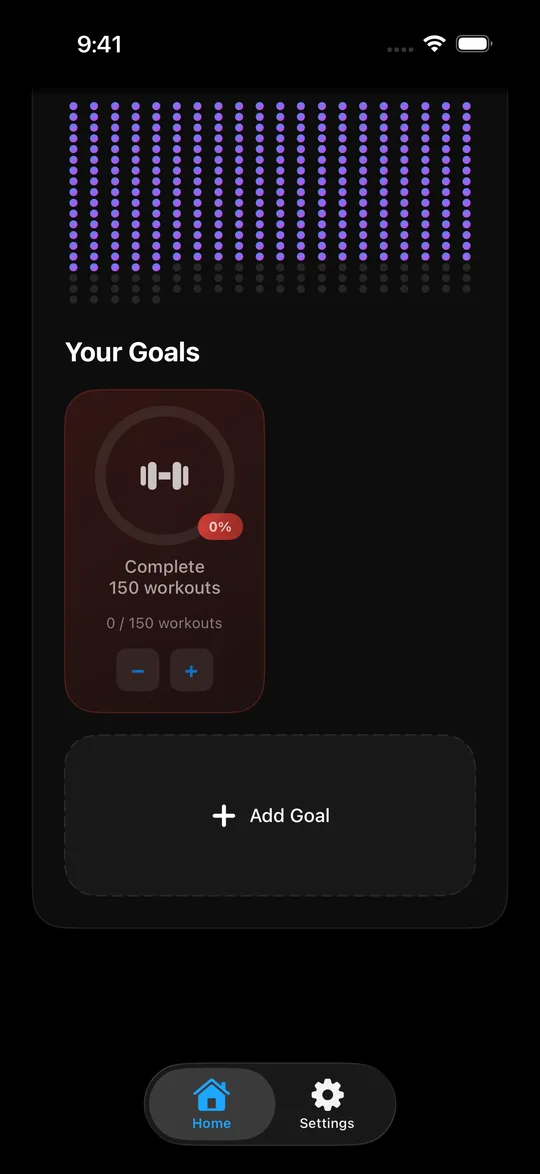
Watching a count climb (12 of 50 workouts, then 13) is a surprisingly strong pull on a day you’d rather skip. Put the goal on a home screen widget so you see it every time you unlock your phone.
7. Get a reminder at the right moment
A reminder at 6:45 for your 7:00 workout is a cue. A reminder at noon for a workout you planned for the evening is noise. Set your reminder window around when you actually train. Motivum’s motivational reminders are personalized to your motivation style, so they read like encouragement, not nagging.
8. Find your reason
Achievers love personal records. Helpers train to keep up with their kids. Creators like variety. Learners like understanding programming and form. Lean into what drives you — find yours with the motivation style quiz.
9. Train with someone
An accountability partner makes skipping socially expensive. A meta-analysis of social influence and exercise found small-to-moderate benefits from workout partners, groups and support from family. Even a quick text check-in each week can keep you honest.
10. Never miss twice
Missed Monday? Fine. Don’t miss Wednesday. One miss is life; two is a pattern. In the gym study, the longer the gap since someone’s last visit, the less likely they were to go again, while in the best-known habit study a single missed day didn’t slow habit formation.
Know when rest is the right call
If you’re sick, injured, or genuinely exhausted, rest is training. The tips above are for the far more common case: you’re fine, just not in the mood. Make it smaller, start anyway, and let the habit do the work. See how Motivum helps with workout motivation.
Key takeaways
- On low-motivation days, shrink the workout instead of skipping it. Ten minutes keeps the habit alive.
- Schedule specific days and times: if-then plans modestly increase physical activity, and same-weekday routines predict who keeps going.
- Track progress where you'll see it, and train with someone if you can.
- Never miss twice: the longer the gap since your last workout, the less likely the next one.
Sources
- Bélanger-Gravel, A., Godin, G., & Amireault, S. (2013). A meta-analytic review of the effect of implementation intentions on physical activity. Health Psychology Review, 7(1), 23–54. doi:10.1080/17437199.2011.560095
- Buyalskaya, A., Ho, H., Milkman, K. L., Li, X., Duckworth, A. L., & Camerer, C. (2023). What can machine learning teach us about habit formation? Evidence from exercise and hygiene. PNAS, 120(17), e2216115120. doi:10.1073/pnas.2216115120 (correction)
- Carron, A. V., Hausenblas, H. A., & Mack, D. (1996). Social influence and exercise: A meta-analysis. Journal of Sport and Exercise Psychology, 18(1), 1–16. doi:10.1123/jsep.18.1.1
Put this into practice
Motivum turns goals into daily progress with personalized motivation. Workout motivation for the days you don't feel like it →