 Motivum
How Long Does It Take to Form a Habit? (It's Not 21 Days)
Short answer: about two months on average — but anywhere from 18 to 254 days. The popular “21 days” figure is a myth. How long it takes depends on how complex the habit is, how consistently you do it, and how strong the cue is.
Where the 21-day myth comes from
In 1960, plastic surgeon Maxwell Maltz wrote in Psycho-Cybernetics that it “usually requires a minimum of about 21 days” to adjust to a change in self-image, describing patients getting used to a new face or a lost limb (UCL habit researcher Benjamin Gardner traces the quote). Over decades of self-help retelling, “a minimum of about 21 days to adjust” became “21 days to form a habit”. It was never a study about habits.
What the research actually found
The most-cited study is by Phillippa Lally and colleagues at University College London, published in the European Journal of Social Psychology in 2010. Ninety-six participants picked a new daily eating, drinking or exercise behavior, did it in the same context each day (for example, after breakfast), and reported each day how automatic it felt.
Key findings:
- Median time to reach automaticity: 66 days. That’s for the 39 participants whose data showed a clear habit curve.
- Range: 18 to 254 days. Some got there in under three weeks; for others the curve pointed to most of a year. The study ran 12 weeks, so the longest times are projections.
- Simpler habits tended to form faster. In the researchers’ words, automaticity peaked sooner for simple actions like drinking water than for routines like doing 50 sit-ups.
- Missing one day didn’t derail it. Missing a single opportunity did not materially affect habit formation.
A 2023 study that ran machine learning on gym check-ins and hospital handwashing data (Buyalskaya and colleagues, PNAS) found a similar story: handwashing habits formed within weeks, while gym habits took months. To see dates for your own habit, try the habit formation calculator.
What makes a habit form faster
1. Make it smaller than you think
The more complex the behavior, the longer it takes. Start with a version so small it feels almost pointless: one push-up, one page, one minute of meditation. Expand once it’s automatic.
2. Attach it to an existing routine
Habits are triggered by cues. The strongest cues are things you already do every day: brushing your teeth, pouring coffee, sitting down at your desk. “After I pour my coffee, I’ll write one sentence in my journal.” This is often called habit stacking.
3. Same cue, same days
Consistency of context matters, but the cue doesn’t have to be a clock time. Lally’s participants tied their habit to a moment like “after breakfast”. In the gym study, the exact time of day mattered little; what predicted the habit was going on the same days each week and not letting long gaps build up. Pick your cue and your days, and stick to them.
4. Make progress visible
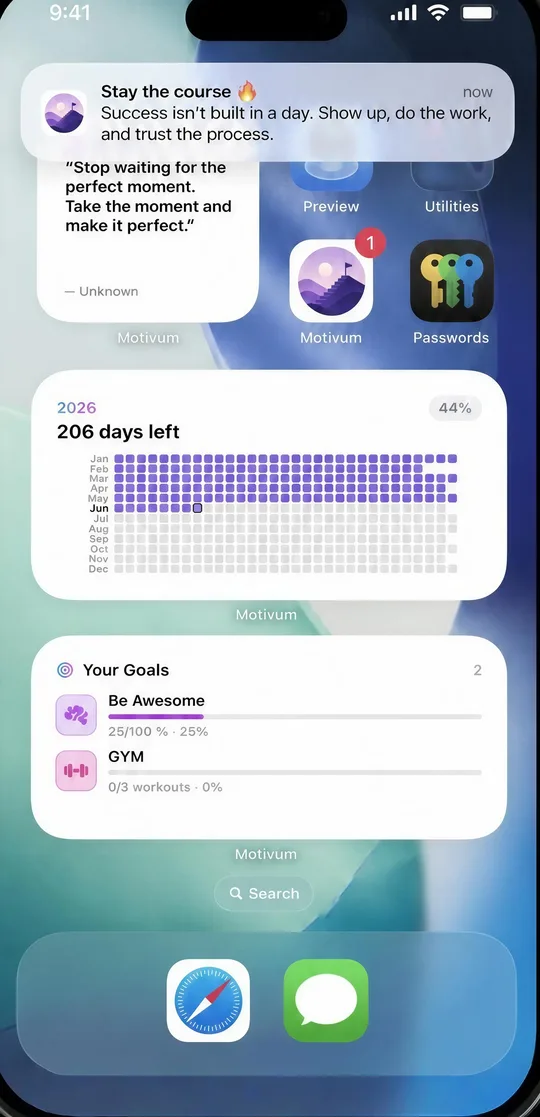
You won’t feel a habit forming day to day — automaticity creeps up slowly. A visible tracker shows you the progress your brain isn’t reporting yet, which keeps you going through the boring middle. Motivum’s habit tracker puts it in a progress ring and on your home screen.
5. Don’t miss twice
Since one miss barely matters, don’t treat it like failure. Treat two misses in a row as the thing to avoid. Weekly goals (e.g. “4 times a week”) build this flexibility in.
A realistic habit timeline
| Phase | Roughly | What it feels like | What helps |
|---|---|---|---|
| Honeymoon | Days 1–10 | Exciting, easy | Set up cues and tracking now |
| The dip | Weeks 2–6 | Boring, effortful, easy to skip | Shrink the habit, rely on reminders |
| Settling | Weeks 6–10 | Less effort, occasional skips | Keep the cue consistent |
| Automatic | ~2+ months | You feel weird not doing it | Consider adding the next habit |
Most people quit in the dip, thinking something is wrong because it isn’t automatic yet. Nothing is wrong. It’s just not day 66. If you’re in the dip right now, these strategies to stay motivated are built for it.
The takeaway
Plan for two months, not three weeks. Start small, anchor the habit to a routine, track it where you’ll see it, and forgive the occasional miss. That’s a system, and it beats willpower (more in discipline vs motivation). If you want motivation for the dip, Motivum sends reminders written for your motivation style, during the hours of the day you choose.
Key takeaways
- The 21-day rule comes from a 1960 self-help book about adjusting to change, not from habit research.
- In the best-known study, habits took a median of 66 days to become automatic, ranging from 18 to 254 days.
- Missing a single day didn't materially slow habit formation; long gaps are what hurt.
- Small habits tied to a consistent cue (after breakfast, on the same weekdays) form faster.
Sources
- Lally, P., van Jaarsveld, C. H. M., Potts, H. W. W., & Wardle, J. (2010). How are habits formed: Modelling habit formation in the real world. European Journal of Social Psychology, 40(6), 998–1009. doi:10.1002/ejsp.674
- Gardner, B., Lally, P., & Wardle, J. (2012). Making health habitual: the psychology of “habit-formation” and general practice. British Journal of General Practice, 62(605), 664–666. doi:10.3399/bjgp12X659466
- Buyalskaya, A., Ho, H., Milkman, K. L., Li, X., Duckworth, A. L., & Camerer, C. (2023). What can machine learning teach us about habit formation? Evidence from exercise and hygiene. PNAS, 120(17), e2216115120. doi:10.1073/pnas.2216115120 (correction, revising the gym estimate to about 2–3 months)
- Maltz, M. (1960). Psycho-Cybernetics. Prentice-Hall. Quote and context: Gardner, B. (2012). Busting the 21 days habit formation myth. UCL Health Behaviour Research Centre.
Put this into practice
Motivum turns goals into daily progress with personalized motivation. A habit tracker that actually gets you to do the habit →