 Motivum
How to Stay Motivated: 12 Strategies That Actually Work
The short answer: you stay motivated by making the next step small, making progress visible, and getting a cue at the moment you need it. Motivation isn’t a personality trait you either have or don’t — it’s a state you can engineer.
Everyone starts a goal fired up. Three weeks later, most of that energy is gone. That isn’t a character flaw; it’s how motivation works. Below are twelve strategies that keep you going after the excitement fades, roughly ordered from “do this today” to “build this over time”.
1. Shrink the next step until it’s almost silly
The biggest motivation killer is a next step that feels heavy. “Go to the gym” is heavy. “Put on gym clothes” isn’t. When you feel resistance, ask: what’s the smallest version of this I could do in two minutes? Do that. Most days you’ll keep going once you’ve started. (For workouts specifically, see these gym motivation tips.)
2. Know your motivation style
People are moved by different things. Some want measurable progress and a scoreboard. Some want to understand why something matters. Some are motivated by helping others; some by making things. When your goals and reminders speak to your driver, they stick. Our free motivation style quiz takes 30 seconds.
3. Turn vague goals into numbers
“Get fit” gives you nothing to aim at. “Work out 3 times a week” does. A number tells you when you’ve won today, and winning is motivating. If you need help, see our SMART goal examples.
4. Make progress visible
You can’t feel motivated by progress you can’t see. Use a progress ring, a wall calendar, a jar of marbles — anything where today’s effort visibly moves something. This is why home screen widgets work: you see your goals every time you unlock your phone.
5. Decide when and where in advance
Psychologist Peter Gollwitzer’s research on implementation intentions found that people who plan “when X happens, I will do Y” are more likely to follow through than people who simply intend to act. A review of 94 studies put the effect at medium to large. Write it down: “After I pour my morning coffee, I’ll read 10 pages.”
6. Get the right nudge at the right time
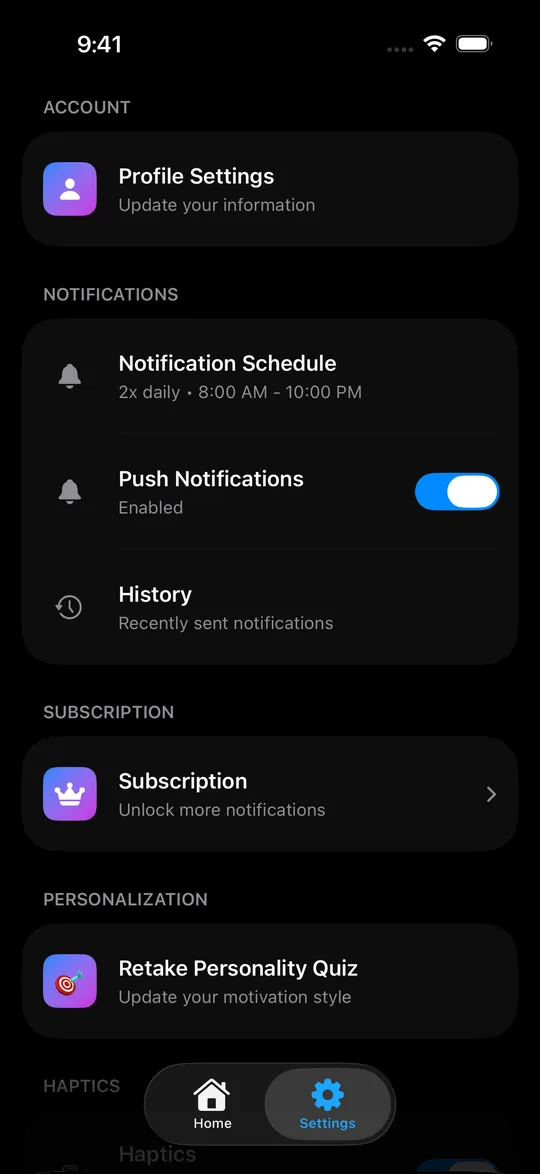
A reminder at the wrong moment is noise. A reminder right when your planned window opens is a cue. Set reminders for the times you actually do the thing — and make them encouraging, not nagging. That’s the idea behind personalized motivational reminders.
7. Track fewer goals
Spreading yourself across ten goals guarantees slow progress on all of them, and slow progress kills motivation. Pick one to five goals for this season. Finish them. Then pick more.
8. Celebrate small wins on purpose
Teresa Amabile and Steven Kramer analyzed about 12,000 daily diary entries from 238 professionals and found that making progress in meaningful work was the single biggest boost to people’s mood and motivation at work on a given day — and that even small wins counted. Notice it. Log it. Say “nice” out loud if you have to.
9. Never miss twice
You will miss days. The danger isn’t the miss; it’s the second miss, which starts a new pattern. Make “never miss twice” your rule and the streak survives real life. Habit research backs this up: one missed day barely matters.
10. Connect the goal to someone
If you’re doing it only for yourself and motivation is low, connect it to someone else: you’re getting fit to keep up with your kids, saving so your partner stresses less. Or find an accountability buddy and check in weekly.
11. Rest deliberately
Burnout looks like a motivation problem but isn’t. If you’re exhausted, the answer is sleep and recovery, not another pep talk. Plan rest days into your goals — weekly targets make this easy.
12. Build the system while you’re motivated
On a high-motivation day, don’t just do more — set up the system that will carry you on a low day: lay out tomorrow’s clothes, schedule reminders, prep the healthy lunch. Your motivated self should be working for your future tired self. (More on this in discipline vs motivation.)
What to do when you’ve already lost motivation
If you’re reading this because you’ve stalled, start here:
- Forgive the gap. Guilt drains energy you need for restarting.
- Shrink the goal by half. If it was 30 minutes, make it 15 for the next week.
- Do the two-minute version today. Not tomorrow.
- Set one reminder for tomorrow at the time you’ll do it.
Motivation follows action far more reliably than action follows motivation. Start tiny, make it visible, and let momentum do the rest.
Key takeaways
- Shrink the next step until it takes two minutes; action usually comes before motivation.
- Decide when and where you'll act. If-then plans have a medium-to-large effect on follow-through.
- Make progress visible and notice small wins: progress on meaningful work is one of the biggest daily boosts to motivation.
- When you stall, halve the goal, do the two-minute version today and set one reminder for tomorrow.
Sources
- Gollwitzer, P. M. (1999). Implementation intentions: Strong effects of simple plans. American Psychologist, 54(7), 493–503. doi:10.1037/0003-066X.54.7.493
- Gollwitzer, P. M., & Sheeran, P. (2006). Implementation intentions and goal achievement: A meta-analysis of effects and processes. Advances in Experimental Social Psychology, 38, 69–119. doi:10.1016/S0065-2601(06)38002-1
- Amabile, T. M., & Kramer, S. J. (2011). The power of small wins. Harvard Business Review, 89(5), 70–80. hbr.org. Expanded in The Progress Principle (Harvard Business Review Press, 2011).
Put this into practice
Motivum turns goals into daily progress with personalized motivation. Motivational reminders written for you, not for everyone →